
WELCOME BONUS 200%
UP TO €1500 + 200
FREE SPINS
UP TO €1500 + 200
FREE SPINS
Home → Games
Casino games at Casinomoonwin
Declining Insurance: The Most Common Blackjack Mistake
The Blackjack Insurance side bet, offered when the dealer shows an Ace, presents a house edge of 7.47% for 6-8 decks. This substantial disadvantage means players are statistically likely to lose a significant portion of their wagers over time. Accepting this bet, especially without card counting, is a direct departure from optimal strategy.
For comparison, the main game of Blackjack with classic rules and a 3:2 payout offers a significantly lower house edge of 0.15%. Even liberal rule variations like Vegas Strip Blackjack maintain a house edge below 0.30%. The insurance bet's house edge is over 30 times higher than standard blackjack.
This unfavorable edge translates to a direct monetary loss for the player. On average, a player placing this bet will lose 7.47% of the total amount wagered on insurance. Over many hands, this erodes the player's bankroll more rapidly than playing the main game.
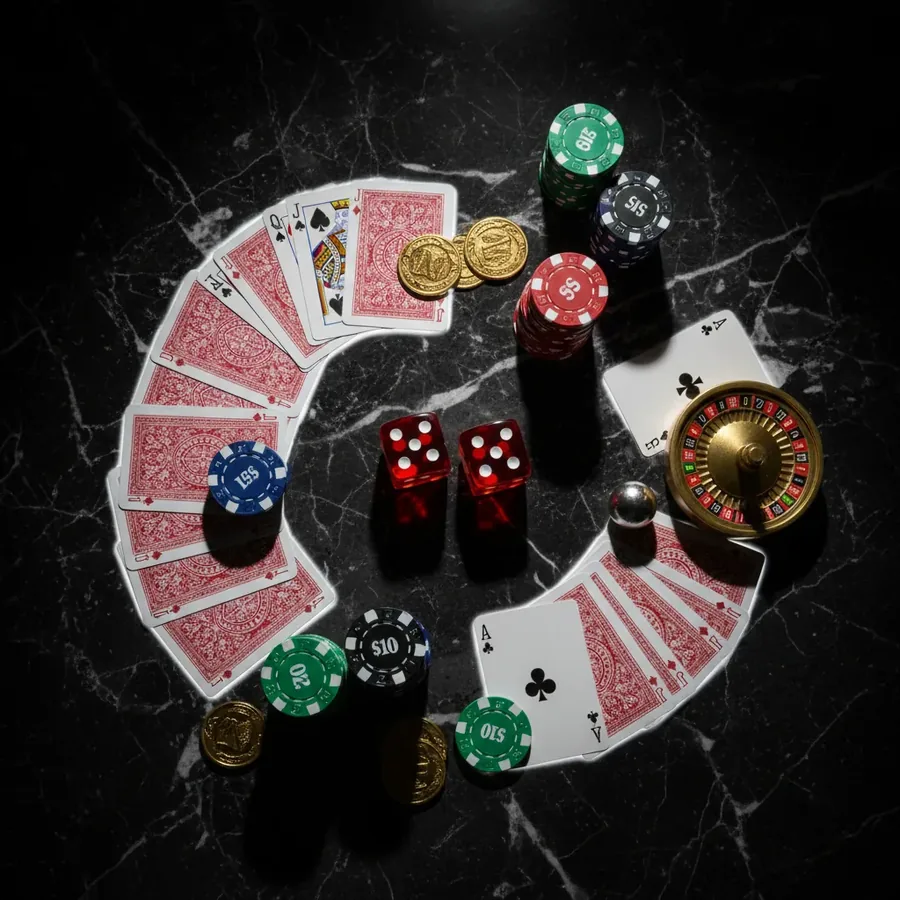
Game Shows: sectors, multipliers, and bet ranges
While specific game show titles are not detailed in the provided data, general principles of such games can be inferred from related table games. For instance, European Roulette, with its 37 sectors, offers a Straight bet payout of 35:1, indicating a potential multiplier effect. The house edge on European Roulette is 2.70%.
Side bets often feature higher multipliers but also come with significantly increased house edges. For example, Baccarat Pair side bets have an RTP of 89.64%, translating to a house edge of 10.36%. This suggests that game show bonus rounds or multipliers might also come with a higher risk profile.
The bet ranges for such games would typically accommodate various player budgets, but the underlying mathematical structure is key. A higher house edge, as seen in Baccarat Tie bets at 14.36%, implies that the potential for large multipliers must be balanced against a statistically higher probability of losing.
Before sitting down: check table bet limits
Understanding table bet limits is crucial for managing your bankroll and ensuring eligibility for certain games. For example, the minimum deposit at Casinomoonwin is 20 EUR. While not a table limit, it sets the initial threshold for participation across the platform.
Specific games, like Blackjack Liberal Vegas Strip, offer a very low house edge of 0.28%. However, the impact of bet limits becomes apparent when considering potential winnings relative to the table's maximum bet. For instance, a high roller might be restricted by the table's upper limit, affecting their potential returns.
Similarly, while not a limit, the contribution of different game types to bonus wagering requirements is important. Table games count 10 percent towards bonus turnover, meaning a player would need to wager 100 EUR on table games to meet 10 EUR of a bonus wagering requirement.
Minimum deposit 20 EUR, table games count 10 percent
The minimum deposit requirement at Casinomoonwin is set at 20 EUR, establishing the entry point for players to engage with the casino's offerings. This figure is a primary consideration for budget-conscious players looking to begin their gaming sessions.
When utilizing bonus funds, the contribution of table games to wagering requirements is noted as 10 percent. This means that for every 1 EUR wagered on a table game, only 0.10 EUR counts towards fulfilling the bonus turnover conditions. For example, a 300% welcome bonus up to €2,000 requires significant play.
This 10 percent contribution rate is considerably lower than the 100 percent attributed to slots. Consequently, a player aiming to clear bonus funds through table games, such as European Roulette with its 2.70% house edge, would need to place substantially more wagers compared to playing slots.
9/6 table: nine for Full House, six for Flush
The mention of a '9/6 table' specifically refers to the paytable for certain Video Poker variants, indicating payouts of nine credits for a Full House and six credits for a Flush. This specific payout structure is characteristic of Jacks or Better variations.
In the context of Video Poker, particularly variations like Deuces Wild, the paytable significantly influences the Return to Player (RTP). A 'Full Pay' version of Deuces Wild offers an RTP of 100.76% under optimal strategy, a rarity in online gaming where most games have a house edge.
While the provided data lists specific Video Poker games, the exact RTP for a generic '9/6 table' without further context of the game variant (e.g., Jacks or Better) is not explicitly stated. However, such a paytable generally represents a more favorable return for the player compared to tables with lower payouts for these hands.
Game categories at a glance
| Category | Examples | Stakes From | Highlight |
|---|---|---|---|
| Slots | Major Millions, San Quentin xWays, Big Bamboo | 0,10 EUR | thousands of titles |
| Table games | Roulette, Blackjack, Baccarat | 0,50 EUR | classic rules |
| Live casino | Mega Wheel, Speed Baccarat | 0,20 EUR | real dealers |
| Jackpot games | Mega Moolah, Divine Fortune, Age of the Gods | 0,20 EUR | progressive pools |
| Instant games | Aviator, Plinko, Mines | 0,10 EUR | fast rounds |
| Video poker | Jacks or Better, Deuces Wild | 0,25 EUR | strategy based |
Double Down: double bet, only one card
The option to double down in Blackjack Liberal Vegas Strip allows a player to double their initial bet in exchange for receiving only one more card. This strategy is often employed when a player holds a strong hand, such as 10 or 11, against a dealer's upcard that suggests a potential for a high total. The mathematical advantage of strategically doubling down can contribute to reducing the house edge.
In Blackjack Liberal Vegas Strip, the RTP stands at 99.72% with a house edge of 0.28%, a figure influenced by optimal play, including when to double down. This favorable RTP is achieved with a combination of liberal rules like 'Dealer Hits Soft 17' (H17) which offers a -0.22% RTP, 'Double After Split' (DAS) which provides a +0.14% RTP, and 'Resplit' (RSA) which adds another +0.08% RTP. Mastering these strategic decisions, including doubling down, is crucial for approaching the theoretical return.
Players utilizing the double down option must be aware that they forgo any further actions after receiving their single additional card. This means no hitting, standing, splitting, or surrendering is possible once the double down bet is placed and the card dealt. Therefore, the decision to double down must be made with a high degree of certainty regarding the potential outcome of the hand, impacting the overall RTP for that specific hand.
Four Blackjack Hand Decisions at a Glance
Blackjack Liberal Vegas Strip, with liberal rules and a 3:2 payout for a blackjack, offers an RTP of 99.72% and a house advantage of 0.28%. Key rules contributing to this low house edge include 'Dealer Stands on Soft 17' (S17), 'Double After Split' (DAS), 'Resplit', and 'Late Surrender'. These favourable conditions mean that players making optimal decisions can significantly minimise the casino's inherent advantage.
In contrast, Blackjack Insurance, a side bet with a 6-8 deck shoe, presents a much higher house edge of 7.47% with an RTP of only 92.53%. This side bet is generally advised against by basic strategy, especially when the true count is less than +3, as it significantly deviates from optimal play. The insurance payout of 2:1 is not mathematically favourable in most standard scenarios.
Considering the impact of rule variations, the Blackjack rule 'Dealer Hits Soft 17' (H17) increases the house edge by approximately 0.22 percentage points compared to 'Dealer Stands on Soft 17' (S17). Conversely, rule modifications like 'Double After Split' (DAS) can decrease the house advantage by around 0.14 percentage points, illustrating how specific decisions and rules directly affect the player's long-term return.
6 Decks vs. 8 Decks in House Edge
A shift from an 8-deck shoe to a 6-deck shoe in Blackjack can result in a marginal decrease in the house edge, by approximately 0.02 percentage points. While this difference is small, it contributes to the overall favourability of the game for the player when combined with other advantageous rules. The mathematical impact of fewer decks is most pronounced in games with lower house edges.
Games such as Blackjack Liberal Vegas Strip, which features an RTP of 99.72% and a house edge of 0.28%, are sensitive to deck composition. A reduction in decks, moving from 8 to 6, would further slightly reduce this already minimal house advantage. This effect is more significant in games where the house edge is larger, making the difference more substantial.
While the impact of using 6 decks versus 8 decks is minor, typically around 0.02% in terms of house edge reduction, it is one of many factors that contribute to the overall player advantage. The most impactful rules, such as 'Blackjack pays 3:2' and favourable splitting or doubling rules, have a far greater influence on the game's RTP than the number of decks alone.
How Much Does One Mistake Cost in 100 Hands?
In Blackjack Liberal Vegas Strip, where the RTP is 99.72% and the house advantage is 0.28%, a single strategic error can significantly impact the player's return over 100 hands. For instance, deviating from basic strategy on a hand that requires a specific decision, like hitting when standing is optimal, can increase the house edge. The standard deviation for this game is 1.15, indicating potential for short-term fluctuations.
Consider Video Poker Deuces Wild – Not So Ugly Ducks (NSUD). This variant boasts a high RTP of 99.73% with a house advantage of only 0.27%. However, making even a minor strategic misstep, such as discarding a card that should be kept according to optimal strategy, can lead to a substantial loss of expected value. In a game with such a low house edge, such errors are costly.
For example, if a player makes one mistake per 100 hands in a game with a 0.50% house edge, they might lose approximately 0.50% of their total wagered amount due to that error. In a game with a higher house edge, like Sic Bo Special Bets where the edge can range from 7.87% to 18.52%, a single mistake can have a far more devastating financial consequence for the player.
Variance at the Table: 1:1 vs. 35:1
The payout ratio difference between a standard 1:1 win, as seen in Baccarat Player at 98.76% RTP, and a high-payout bet like a Straight bet in European Roulette (35:1 payout), highlights significant variance. While a 1:1 payout offers consistent, smaller returns, the 35:1 payout promises a large win but occurs much less frequently, directly impacting the player's risk and reward profile.
European Roulette, with a 97.30% RTP and a 2.70% house edge, exemplifies how different bet types create variance. A 'Red/Black' or 'Odd/Even' bet pays 1:1, offering a relatively stable experience. In contrast, a 'Straight' bet on a single number pays 35:1, carrying a much higher risk but a proportionally larger potential reward, showcasing extreme variance.
In Baccarat, the 'Player' bet offers a 1:1 payout with an RTP of 98.76% and a low house edge of 1.24%. This contrasts sharply with side bets like 'Baccarat Tie' with an 8:1 payout and a substantial 14.36% house advantage, or 'Baccarat Player Pair / Banker Pair' at 11:1 with a 10.36% house edge. These side bets introduce significantly higher variance compared to the main game bets.
En Prison on Zero Gives Second Chance
European Roulette features 37 pockets, including a single zero. When the ball lands on zero, certain even-money bets may be 'en prison', meaning they are held for the next spin. This rule offers a second chance for these bets to win, effectively reducing the house edge on such wagers.
For a bet like Red/Black or Odd/Even, the standard house edge on European Roulette is 2.70%. The 'en prison' rule provides a theoretical mitigation of this edge, as a zero result does not automatically mean a loss for affected bets. The RTP for European Roulette stands at 97.30%.
This rule significantly impacts the player's experience on even-money bets. Instead of an immediate loss on zero, the bet is preserved, offering a potential return to parity in the subsequent spin. This makes the game more forgiving for players who favour these types of wagers.
What doesn't count: bets over 5 EUR
Certain bonus terms may exclude larger bet sizes from contributing to wagering requirements. For instance, bets exceeding 5 EUR might not count towards the 40x wagering requirement on the 300% welcome bonus up to €2,000. This limitation ensures progressive wagering rather than rapid completion with a few large bets.
The welcome bonus offers a substantial 300% match up to €2,000, alongside 100 free spins. However, the contribution of table games to the bonus turnover is 10%, significantly lower than slots at 100%. This disparity influences player strategy for bonus clearance.
Players aiming to fulfil the bonus wagering must be mindful of the bet limits. A bet of 10 EUR, for example, would not contribute to the required turnover, meaning a player would need to place 400 bets of 10 EUR (totaling 4,000 EUR) to meet a 4,000 EUR wagering requirement, if allowed.
Punto Banco: 5 Percent Commission on Banker Wins
In Baccarat, specifically the Punto Banco variant, a 5% commission is applied to winning Banker bets. This commission reduces the payout from a standard 1:1 to 0.95:1. The RTP for the Banker bet, accounting for this commission, is 98.94%.
This commission is a key factor in the house edge for Banker bets, which stands at 1.06%. Without this commission, the Banker's inherent advantage in drawing the third card would make it a far more favourable bet. The commission aims to balance the game's mathematics.
For players, this means that for every 100 EUR wagered and won on the Banker, only 95 EUR is returned after the commission. This differs from the Player bet, which offers a direct 1:1 payout with a slightly lower RTP of 98.76% and a house edge of 1.24%.
Roulette Wheel with 37 vs 38 Pockets
European Roulette utilizes a wheel with 37 pockets, numbered 1 through 36 plus a single zero. This contrasts with American Roulette, which has 38 pockets, including both a single zero and a double zero. The presence of the double zero significantly increases the house edge.
The RTP for European Roulette is 97.30%, resulting in a house edge of 2.70%. In contrast, a wheel with 38 pockets would typically have a lower RTP and a higher house edge due to the additional betting opportunities and the increased probability of the house winning.
This difference in the number of pockets directly affects all bets placed on the roulette table. A straight-up bet on a single number, for instance, pays 35:1 on both types of wheels, but the odds of winning are mathematically less favourable on the 38-pocket wheel.
Straight 35:1 Instead of 36:1: Where House Edge Originates
The house edge in roulette, particularly European Roulette, originates from the payout structure for single-number bets. A straight-up bet pays 35:1, meaning a 1 EUR bet wins 35 EUR plus the original stake. However, there are 37 possible outcomes.
If roulette paid 36:1 for a straight-up bet on a 37-pocket wheel, the game would theoretically offer a 0% house edge or even a player advantage. The discrepancy between the 37 possible outcomes and the 35:1 payout creates the inherent advantage for the casino.
This 35:1 payout ratio, applied across all bets on the European Roulette wheel with its 97.30% RTP, generates the casino's consistent 2.70% edge. Even bets like Red/Black or Odd/Even offer a 1:1 payout, but the zero pocket means these bets have a lower probability of winning than losing.
Contact
Live - online chat
Banking









Providers












moonwin casino 2025